HEALTH NEWS ADVERTORIAL
What are the symptoms of a lack of magnesium?
The body doesn't whisper magnesium shortage in one place — it signals through sleep, muscles, mood, and energy at once.
See why single-form magnesium often leaves half the symptoms untouched — and what a full-spectrum approach changes.

Most people who ask "what are the symptoms of a lack of magnesium?" are already living with several of them — they just don't connect the dots. Tight calves at night. A mind that won't shut off. Afternoon crashes. Twitchy eyelids. Salt cravings. A resting heart that feels a little too loud.
For years, the supplement industry sold a simple fix: pick one "best" magnesium form, take it before bed, and wait. Glycinate for sleep. Citrate for digestion. Oxide because it's cheap and high-dose on the label.
But magnesium is not a single-system nutrient. It is a cofactor in hundreds of enzymatic reactions across muscle, nerve, heart, bone, and stress-response pathways. When levels run low, symptoms rarely show up in only one place.
That is why so many adults "try magnesium" and still wake up cramped, wired, or drained. The villain is not magnesium itself — it is the Single-Form Absorption Ceiling: one form can only open one set of transport doors, while the rest of the body stays under-supplied.
Once you map the real symptom clusters, the pattern becomes obvious — and so does the kind of magnesium coverage that actually matches it.
"Magnesium is a cofactor in more than 300 enzyme systems that regulate diverse biochemical reactions in the body, including protein synthesis, muscle and nerve function, blood glucose control, and blood pressure regulation."
— NIH Office of Dietary Supplements
Magnesium Fact Sheet for Health Professionals
"Symptoms of magnesium deficiency include loss of appetite, nausea, vomiting, fatigue, and weakness. As magnesium deficiency worsens, numbness, tingling, muscle contractions and cramps, seizures, personality changes, abnormal heart rhythms, and coronary spasms can occur."
— NIH Office of Dietary Supplements
Clinical magnesium deficiency progression overview
"Dietary surveys of people in the United States consistently show that intakes of magnesium are lower than recommended amounts."
— NIH Office of Dietary Supplements
Population intake gap noted across U.S. dietary surveys
And that's just the clinical shortlist. In real life, low magnesium often shows up as a cluster of "everyday" complaints people blame on stress, aging, or bad sleep hygiene.
Why Common Magnesium Fixes Still Leave Symptoms Behind
| Common Choice | Why It Fails | What You Still Notice |
|---|---|---|
| Magnesium Oxide High-dose drugstore staple |
Very low absorption for many people; much of the dose stays in the gut and acts as a laxative rather than a systemic refill. | Loose stools, little change in cramps, sleep, or daytime calm. |
| Single-form Glycinate "Best for sleep" marketing |
Excellent for calming pathways, but one transport preference cannot fully cover heart, muscle recovery, and broad cellular demand alone. | Better wind-down some nights, but residual twitches, tension, or energy dips remain. |
| Citrate-only or random blends Incomplete coverage |
May help digestion or one absorption route while leaving other tissue affinities underfed — especially when stress and sweat losses are high. | Partial relief that plateaus; symptoms migrate instead of resolving. |
Key takeaway: Magnesium deficiency symptoms are multi-system. A single-form product can only partially answer a multi-system problem.
The Multi-Story Building Problem

Think of your body like a multi-story building. Sleep and nervous system calm live on one floor. Muscle recovery lives on another. Heart rhythm and electrolyte balance occupy their own level. Energy metabolism runs through the whole structure.
Single-form magnesium is like installing plumbing that only reaches the ground floor. Water arrives — sometimes impressively — but the upper floors stay dry. That is why one symptom can improve while three others keep complaining.
A full-spectrum complex is different plumbing: multiple forms, multiple pathways, coverage that can move magnesium where different tissues actually use it. The goal is not "more milligrams on a label." The goal is reaching more floors.
Total Body Problem
Magnesium shortage rarely stays local
When intake, absorption, stress load, or sweat losses outpace supply, the body rationing system shows up as stacked symptoms — not one neat diagnosis.
"If your symptoms span sleep, muscle, mood, and energy, you are not imagining a connection — magnesium sits at the intersection of all four."
*These are reported associations and deficiency-related clinical signs in literature; they are not a diagnosis. Seek medical care for cardiac symptoms, seizures, or severe neurological changes.
What You Actually Need to Address Magnesium Deficiency Symptoms
1. Multi-form coverage, not one hero form
Different magnesium salts and chelates use different absorption preferences and tissue affinities. Symptom clusters that span sleep, muscle, and heart need more than one doorway.
2. Forms that respect gut comfort
If the dose mostly loosens the bowels, it never becomes a full-body refill. Better-tolerated forms help you stay consistent long enough to matter.
3. Nervous-system calm support
Restless nights, racing thoughts, and muscle tension often travel together. Glycinate-style calming support is useful — but incomplete as a solo strategy.
4. Muscle and electrolyte recovery
Cramps, twitches, and post-workout tightness are classic low-magnesium signals — especially with heavy sweating, low vegetable intake, or high caffeine.
5. Heart-aware mineral support
Magnesium participates in normal cardiac electrical stability and blood-pressure regulation. Forms paired with taurine pathways are often included for broader coverage.
6. Clean daily consistency
Deficiency symptoms reverse with steady repletion, not weekend megadoses. You need a formula you can take every day without synthetic junk or guesswork.
Founder Note
"We built Magnesium Complex because too many people were doing the right thing — taking magnesium — and still dealing with the same cramps, shallow sleep, and afternoon flatness. One form was never going to cover a whole body. So we stacked seven complementary forms into one clean daily formula."
— Anthony, Founder of Wild Foods Co.
Introducing
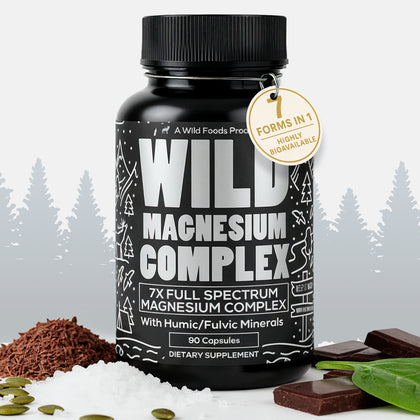
Magnesium Complex | 7-in-1 Complete Spectrum Formula
Seven complementary magnesium forms designed for multi-system coverage — sleep, muscle, calm, and daily resilience.
Customer Snapshot
92%
report easier wind-down & sleep comfort*
4.7★
from 1,000+ Wild families*
<1%
refund rate*
4×
sold out last year*
*Brand-reported customer feedback snapshots — individual results vary.
"I thought my night cramps were just 'getting older.' Within two weeks on the complex, the calf grabs stopped waking me up. Sleep feels deeper, and I'm not as wired at 2am."
— Rachel M., 47
"I had tried glycinate alone for months. It helped a little. Switching to the 7-in-1 was the first time my daytime tension and evening restlessness both moved in the right direction."
— Daniel K., 39
"The eyelid twitches and chocolate cravings were my tell. Once those quieted down, I realized how many small symptoms had been magnesium-related all along."
— Priya S., 42
What Many People Notice Over 30 Days
Price Anchor
Clinic-style magnesium protocols and stacked single bottles can run far more per month — without coordinated forms.
Wild Magnesium Complex puts seven complementary forms in one daily formula so you are not juggling three bottles to chase three symptoms.
Limited Batch Availability
This formula has sold out multiple times. If multi-system magnesium coverage is on your list, grab a bottle while this batch is in stock.
Wild Promise
Try it with confidence. If Magnesium Complex is not a fit, Wild Foods stands behind your order with a straightforward satisfaction guarantee.
Next Step
Stop treating magnesium deficiency one symptom at a time
Give your sleep, muscles, calm, and energy the multi-form coverage they have been missing.
Shop Magnesium Complex →🍫 Boost your wellness with the power of magnesium-rich cocoa powder! Dive into the benefits and unlock a world of flavor and health today! 🌟
STUDIES & SOURCES REFERENCED ▾
- National Institutes of Health, Office of Dietary Supplements. Magnesium — Fact Sheet for Health Professionals. https://ods.od.nih.gov/factsheets/Magnesium-HealthProfessional/
- Volpe SL. Magnesium in disease prevention and overall health. Adv Nutr. 2013;4(3):378S-383S. PMID: 23674807.
- DiNicolantonio JJ, O'Keefe JH, Wilson W. Subclinical magnesium deficiency: a principal driver of cardiovascular disease and a public health crisis. Open Heart. 2018;5(1):e000668. PMID: 29387426.
- Abbasi B, et al. The effect of magnesium supplementation on primary insomnia in elderly: A double-blind placebo-controlled clinical trial. J Res Med Sci. 2012;17(12):1161-1169. PMID: 23853635.
- Garrison SR, et al. Magnesium for skeletal muscle cramps. Cochrane Database Syst Rev. 2020;9(9):CD009402. PMID: 32956536.
- Schwalfenberg GK, Genuis SJ. The Importance of Magnesium in Clinical Healthcare. Scientifica (Cairo). 2017;2017:4179326. PMID: 29093983.
- Workinger JL, Doyle RP, Bortz J. Challenges in the Diagnosis of Magnesium Status. Nutrients. 2018;10(9):1202. PMID: 30200431.
*These statements have not been evaluated by the Food and Drug Administration. This product is not intended to diagnose, treat, cure, or prevent any disease.