HEALTH NEWS ADVERTORIAL
What is the main benefit of magnesium?
It is not just better sleep. The mineral that makes ATP, calms NMDA receptors, and stops nighttime cramps cannot do those jobs from a single cheap form.
You will see why “just take magnesium” fails, how seven body systems compete for the same mineral, and what full-spectrum coverage actually looks like.

The industry’s favorite line is almost always the same: “Take magnesium. It helps you sleep.” Pharmacies stack citrate, oxide, and glycinate next to each other as if they were interchangeable versions of one benefit. Influencers pick a single form, a single symptom, and a single bedtime ritual — then call it solved.
What nobody on the label mentions is the Single-Form Absorption Ceiling. Magnesium is a cofactor in more than 300 enzymatic reactions. Different chemical forms prefer different tissues. Oxide barely absorbs. Citrate leans toward the gut. Glycinate leans toward the nervous system. One capsule can look “high potency” on paper and still leave your heart, muscles, and cellular energy underfed.
The evidence points somewhere else entirely.
Magnesium sits at the center of ATP, the molecule every cell uses as fuel. Without adequate magnesium, ATP stays unstable and energy production stalls even if you eat enough calories. The same mineral blocks excess NMDA receptor activity in the brain, which is why low status shows up as a wired-tired mind at 11 p.m. It also regulates calcium at the neuromuscular junction — when magnesium is short, calcium floods the muscle fiber and you get the 2 a.m. calf cramp. TRPM6 and TRPM7 channels, intestinal pH, and competing minerals all decide how much of a given form ever reaches those jobs. A 400 mg oxide tablet can deliver a fraction of that number into blood, and almost none of it into the systems you actually feel.
This isn’t a minor nuance. It’s the reason millions of people take “magnesium for sleep,” still wake unrefreshed, still get afternoon crashes, and still assume the mineral does not work for them.
"Magnesium is required to produce ATP. If you are low in magnesium, you are low in cellular energy — which is why fatigue, poor sleep, and muscle tightness so often travel together."
Carolyn Dean, MD, ND
Paraphrased from The Magnesium Miracle (updated editions) and related clinical writing on magnesium as an ATP cofactor.
"In older adults with insomnia, daily magnesium improved sleep time, sleep efficiency, and melatonin-related markers compared with placebo — a reminder that the “sleep benefit” is downstream of biochemistry, not a sedative effect."
Abbasi et al., Journal of Research in Medical Sciences (2012)
Peer-reviewed randomized trial; PubMed PMID 23853635.
"Dietary surveys continue to show that a large share of U.S. adults do not meet recommended magnesium intakes from food alone, which helps explain why symptoms cluster even in people who “eat pretty well.”"
National Institutes of Health, Office of Dietary Supplements
Paraphrased from the NIH ODS Magnesium Fact Sheet for Health Professionals.
And that’s just the start. When the right forms never reach muscle, nerve, and mitochondria at the same time, you get a partial benefit and a full set of leftover symptoms.
Why Most Magnesium “Fixes” Still Leave You Tired
| What people take | Why it fails | What you still notice |
|---|---|---|
| Magnesium oxide The cheap drugstore default |
Very low bioavailability. Most of the dose stays in the gut, which is why the main “effect” is often a bathroom trip, not calmer sleep. | Same 2 a.m. mind, same tight calves, plus loose stools if you raise the dose. |
| Single-form glycinate or citrate The “premium” upgrade |
Better absorption into one lane. Glycinate favors calming pathways; citrate favors digestion. Neither is a whole-body mineral strategy. | Sleep may soften a little while daytime energy, recovery, and muscle ease stay stuck. |
| Two-form “sleep blend” The advanced-looking bottle |
Still a coverage gap. Heart rhythm, ATP production, and bone-mineral teamwork need forms that two-ingredient formulas rarely include. | You feel “somewhat better” and stop there — never realizing half the systems are still running on empty. |
"The main benefit of magnesium is not a single symptom disappearing. It is every magnesium-dependent system getting enough of the mineral at the same time."

One researcher compares single-form magnesium to a multi-story building whose plumbing only reaches the ground floor. The lobby looks wet. The pipes are “working.” Upstairs, the bathrooms are dry, the radiators are cold, and nobody can figure out why the building still feels broken.
That is the Single-Form Absorption Ceiling in plain language. Oxide may never leave the basement. Glycinate may fill the nervous-system floor and leave muscle and mitochondria waiting. You did not imagine the leftover cramps or the 3 p.m. crash. Those floors never got water.
A full-spectrum complex is the same building with risers to every story. Sleep, muscle ease, and cellular energy are not competing products. They are floors on one plumbing system. You weren’t taking the wrong mineral. You were taking an incomplete version of it.
Magnesium deficiency doesn’t just affect sleep. It affects energy. Muscle. Mood. Heart rhythm. Blood sugar handling. Bone. Recovery after training.
Systems that share the same mineral
Ask “what is the main benefit of magnesium?” and most answers pick a favorite floor: sleep, anxiety, or cramps. Biochemically, the main benefit is that magnesium is the spark plug for all of those at once. ATP will not form correctly without it. GABA signaling stays noisy without it. Muscle fibers stay contracted without it.
That is why a sleep-only protocol can look like a win for two weeks and then stall. You padded one system and starved the rest. Stress, sweat, caffeine, and low-magnesium soil already tax the pool. A single form cannot refill a whole-body deficit.
The practical question is not “which symptom should I target.” It is “which coverage actually reaches the systems that share this mineral.” Until the answer is total-spectrum, the leftover symptoms will keep rotating.
A single-form magnesium pill can’t solve a whole-body problem. Which means the only real solution is total-spectrum coverage.
What You Actually Need From Magnesium
Forget brand names for a moment. If the main benefit is whole-body function, the formula has to cover the jobs magnesium actually does — not just the one that photographs well on a sleep-hack thumbnail.
Nervous system and sleep support
You need a form that can settle NMDA overactivity and support the wind-down chemistry behind falling asleep. A gut-only salt will not do this job, no matter how many milligrams are printed on the label.
Cellular energy production
ATP, the cell’s energy currency, is biologically an ATP-magnesium complex. Daytime fatigue that coffee cannot fix is often this pathway running short — not a willpower problem.
Muscle relaxation and recovery
Magnesium lets muscle fibers release after contraction. Night cramps, jaw tension, and post-workout tightness are the same calcium-magnesium imbalance showing up in different rooms.
Cardiovascular and rhythm support
Heart muscle is still muscle. Electrolyte balance at the cell membrane needs magnesium in the mix, not only potassium and sodium from a sports drink.
Stress-axis buffering
Chronic stress dumps magnesium. Low magnesium makes the stress response louder. You need enough mineral reaching that loop or the “wired at night, flat in the morning” pattern keeps winning.
Absorption that survives the gut
A high milligram number is theater if the form does not absorb. You need multiple bioavailable forms plus an uptake helper so the dose you swallow is the dose your tissues can use.
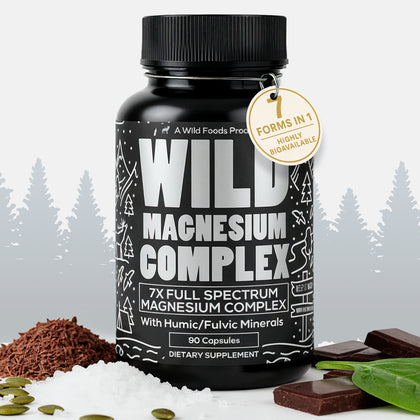
After hundreds of hours of research, sifting through high-quality studies, and examining every multi-form magnesium formula we could find, only one product met every requirement on that list — a seven-form complex built for total-body coverage instead of a single bedtime claim.
The Story Behind the Formula
Colin Stuckert, founder of Wild Foods, built this product because he needed it. “I was tired all the time. So I did a minerals test and found I was deficient in some key minerals, with magnesium at the top of the list. When I started fixing the issue, the change was so profound that I knew I had to bring a Wild version to the market.” The brief: science-backed, whole-food-first, nothing synthetic — and broad enough to cover every system at once.
Introducing
Wild Magnesium Complex
The 7-in-1 Full Spectrum Magnesium Supplement Built for Total-Body Coverage
✓ 450mg elemental magnesium
✓ 7 forms of magnesium in one formula
✓ Humic/Fulvic Monatomic Blend for absorption
✓ Zero fillers, binders, or synthetic additives
✓ Third-party purity tested
✓ cGMP-certified facility, Made in the USA
✓ Vegan-friendly, soy-free, gluten-free
✓ Doctor-recommended
While stock lasts, you can save up to $10 when you purchase two bottles of Wild Magnesium Complex. The current batch is 79% sold — the last batch sold out completely.
CHECK AVAILABILITY →What Customers Are Reporting
Customer Results — Wild Magnesium Complex
92%
sleep easier, wake up clear
<1%
refund rate
4.7★
from 1,000+ families
4x
sold out last year
★★★★★ Verified Buyer
"I kept asking what magnesium was even for. After a month of the complex, the answer was obvious: I fall asleep faster, the night cramps stopped, and I am not dragging at 3 p.m."
— Maya R.
★★★★★ Verified Buyer
"Glycinate alone helped my mind a little. This is the first time my sleep, recovery, and morning energy moved together."
— Chris P.
★★★★★ Verified Buyer
"I was the person who said magnesium did nothing. Turns out I was taking oxide. Different formula, different body."
— Elena K.
What to Expect — Month by Month
MONTH 1 — Nervous system notices first
Many people report an easier wind-down and fewer middle-of-the-night muscle grabs as tissues begin to refill. Bowel tolerance is typically better than with oxide because the forms are split.
MONTHS 2–4 — Energy and recovery catch up
ATP-related fatigue often eases next. Workouts stop leaving you wrecked for two days. The “main benefit” starts looking less like one symptom and more like a quieter whole day.
MONTHS 4–6 — The baseline holds
With consistent intake, sleep architecture, muscle ease, and daytime calm tend to stabilize. This is coverage, not a one-night sedative.
While stock lasts, you can save up to $10 when you purchase two bottles of Wild Magnesium Complex. Check availability before this batch is gone.
CHECK AVAILABILITY →Most people already spend more than this on a daily coffee. Wild Magnesium Complex breaks down to well under the cost of that habit, with a 90-day window to feel the difference across sleep, energy, and recovery — not a single night of “maybe I slept.”
⚠ SUPPLY UPDATE
Current batch: 79% sold. This product has sold out 4 times in the past year. Next batch: 2–4 weeks out. If you’re reading this, stock is still available.
90-Day 100% Money-Back Guarantee
Take three full months. Feel the difference — or pay nothing, no questions asked. Less than 1% of customers have ever asked for it back.
Your sleep, your energy, and your recovery can’t wait.
2026 stock is moving. Full-spectrum coverage while this batch is still on the shelf.
TRY OUR RISK-FREE OFFER →Made in the USA · Third-party tested · 90-day money-back guarantee
🍫 Boost your wellness with the power of magnesium-rich cocoa powder! Dive into the benefits and unlock a world of flavor and health today! 🌟
STUDIES & SOURCES REFERENCED ▾
- National Institutes of Health, Office of Dietary Supplements. “Magnesium — Fact Sheet for Health Professionals.” ods.od.nih.gov
- Abbasi B, et al. “The effect of magnesium supplementation on primary insomnia in elderly: A double-blind placebo-controlled clinical trial.” J Res Med Sci. 2012. PMID: 23853635. PubMed
- Boyle NB, Lawton C, Dye L. “The effects of magnesium supplementation on subjective anxiety and stress — a systematic review.” Nutrients. 2017. PubMed 28445426
- Rosanoff A, Weaver CM, Rude RK. “Suboptimal magnesium status in the United States: are the health consequences underestimated?” Nutr Rev. 2012. PubMed 22364157
- Volpe SL. “Magnesium in disease prevention and overall health.” Adv Nutr. 2013. PubMed 23674807
- Arab A, et al. “The role of magnesium in sleep health: a systematic review of available literature.” Biol Trace Elem Res. 2023. PubMed 35184264
- Rawji A, et al. “Examining the Effects of Supplemental Magnesium on Self-Reported Anxiety and Sleep Quality: A Systematic Review.” Cureus. 2024. PMC10966630
*These statements have not been evaluated by the Food and Drug Administration. This product is not intended to diagnose, treat, cure, or prevent any disease.