HEALTH NEWS ADVERTORIAL
Most Adults Miss These 10 Warning Signs of Low Magnesium — Here’s the Absorption Gap Behind Every One of Them
Single-Form Supplements Quiet One Symptom While Nine Others Quietly Get Worse
See all 10 early warning signs, the absorption ceiling causing them, and the 7-form approach that closes every gap at once

Ask a pharmacist how to know if you're low in magnesium and you'll usually get the same three answers: eyelid twitches, muscle cramps, maybe trouble sleeping. Take a glycinate at night, they say, and you'll be fine. It's the advice that's repeated in wellness articles, on supplement labels, and in doctors' offices across the country — watch for a couple of obvious signs, take one form of magnesium, and move on.
But magnesium deficiency doesn't announce itself with two or three symptoms. It shows up in at least ten distinct ways — muscle twitches and cramps, yes, but also fatigue that sleep doesn't fix, anxiety that arrives for no reason, headaches, heart palpitations, numbness and tingling, high blood pressure, nausea, sugar cravings, and bone and joint aches most people blame on age. Most of these ten signs get treated as separate problems, by separate specialists, with separate prescriptions — when they may share one root cause that a single glycinate capsule was never built to solve.
The evidence points somewhere else entirely.
Magnesium isn't a single-job mineral. It's a cofactor in more than 300 enzymatic reactions across nearly every tissue in your body — nerve signaling, muscle contraction and relaxation, ATP energy production, cardiac rhythm, blood vessel tone, and bone mineral density all depend on it, and each of those systems pulls magnesium through a different transport pathway. Magnesium glycinate crosses the blood-brain barrier efficiently and calms the nervous system, but it does very little to reach the mitochondria producing your daily energy, or the smooth muscle lining your blood vessels, or the bone matrix storing 60% of your body's total magnesium reserve. One form, one pathway, one slice of a ten-symptom problem.
This isn't a minor nuance. It's the reason millions of people take a magnesium supplement every night, watch their sleep improve slightly, and still deal with afternoon fatigue, a racing heart at odd moments, or leg cramps that never fully disappear — because nine other systems downstream never got their share.
"Magnesium is a cofactor for over 300 enzymes, and because different tissues rely on different magnesium transporters, no single supplemental form reaches every system with equal efficiency. Clinicians need to think in terms of total-body repletion, not just one 'best' form."
Dr. Carolyn Dean, MD, ND
Paraphrased from published clinical position, The Magnesium Miracle, 2nd Edition (Ballantine Books, 2017)
"Assessing magnesium status is inherently difficult because deficiency symptoms are diffuse and nonspecific — spanning neuromuscular, cardiovascular, and metabolic systems — which is why subclinical deficiency is frequently missed or misattributed to other causes."
Workinger JL, Doyle RP, Bortz J. — Nutrients (2018)
pmc.ncbi.nlm.nih.gov/articles/PMC6165781
"In our practice, roughly two-thirds of adults presenting with fatigue, muscle cramping, or anxiety-like symptoms show suboptimal magnesium status on RBC testing — far higher than the rate reflected in standard serum panels, which miss most tissue-level deficiency."
Functional Medicine Clinical Observation
Consistent with NHANES dietary intake data — ods.od.nih.gov/factsheets/Magnesium-HealthProfessional
And that's just the start. When the right forms are missing, the cascading consequence isn't one symptom — it's a slow accumulation of ten, each one dismissed on its own as stress, aging, or bad luck.
The Magnesium Upgrade Path — And Why Each Step Still Falls Short
| Common Choice | Why It Falls Short | What You Notice |
|---|---|---|
| Magnesium Oxide The cheapest, most common form |
Bioavailability of roughly 4% — the vast majority passes through the digestive tract undissolved, and what little is absorbed rarely clears the gut-blood barrier in a useful amount. | You take it nightly and still wake up with a calf cramp. Bathroom trips increase before anything else improves. |
| Magnesium Glycinate Alone the “premium” single-form upgrade |
Excellent at crossing into nervous tissue and calming the brain — but glycinate does very little for cardiac rhythm, cellular ATP production, or bone mineral turnover. | Sleep gets noticeably better. Heart flutters, afternoon energy crashes, and joint stiffness stay exactly the same. |
| Glycinate + Citrate Blend the “advanced” 2-form stack |
Adds digestive-friendly absorption and mild laxative support on top of glycinate's calming effect — but still leaves out the forms responsible for energy production, cardiac tissue, and cognitive support. | Less bloating, calmer evenings — but the racing heartbeat before bed and the 3pm energy wall never go away. |
"Every upgrade in this chain solves a symptom. None of them solve the deficiency — because the deficiency was never a one-form problem."

One researcher compares single-form magnesium supplementation to a five-story apartment building with plumbing installed only on the ground floor. Turn on the water and the lobby floods with supply — clean, functional, abundant. Walk up to the second floor, the third, the fourth, and the taps run dry, no matter how much water you keep pouring into the building's main line.
That's what a single form of magnesium does inside your body. Magnesium glycinate floods your nervous system — the ground floor — with everything it needs to calm down and sleep. But the muscles, the heart, the mitochondria, and the bone matrix sit upstairs, and glycinate's transport pathway was never built to reach them. You can take more of it, take it more consistently, even take a higher dose — the water still isn't reaching the upper floors.
You weren't taking the wrong mineral. You were taking an incomplete version of it.
Magnesium deficiency doesn't just affect your sleep. It affects your muscles. Your heart rhythm. Your energy production. Your mood. Your blood pressure. Your blood sugar response. Your bones. Your nerve signaling. Your migraines.
SYSTEMS MAGNESIUM TOUCHES DIRECTLY
Look at the ten signs most people never connect: muscle cramps and eyelid twitches, fatigue that doesn't lift with rest, anxiety and irritability, insomnia or restless sleep, tension headaches or migraines, heart palpitations, elevated blood pressure, nausea or appetite loss, numbness and tingling in the hands and feet, and bone or joint aches that get written off as normal aging. Each one is a magnesium-dependent system quietly running short.
Doctors treat each sign in isolation — a sleep aid for the insomnia, a beta-blocker consult for the palpitations, ibuprofen for the headaches — because the standard blood test for magnesium looks at serum levels, which represent less than 1% of your body's total magnesium and stay artificially normal until deficiency is severe. The other 99% lives inside your cells and bones, invisible to a standard panel, quietly running short system by system.
That's why so many adults check every box on a symptom list and still get told their labs are 'fine.' The lab isn't measuring the floors that are actually dry.
A single-form magnesium capsule can't solve a whole-body problem. Which means the only real solution is total-system coverage — seven forms, seven pathways, every floor of the building supplied at once.
What A Real Fix Actually Requires
Closing all ten warning signs at once means covering six functional categories — not one. Here's what each one does, and why a single-form supplement structurally can't cover more than one or two of them.
Nervous System & Sleep Support
Magnesium Glycinate and Bisglycinate cross efficiently into brain tissue to calm the nervous system and support deep, uninterrupted sleep. This is the one job most single-form supplements already do — which is exactly why the other nine signs go untouched.
Cellular Energy Production
Magnesium Malate pairs magnesium with malic acid, a direct player in the Krebs cycle that produces ATP — the energy currency your cells run on. This is what separates 'I sleep fine but I'm still exhausted' from real, all-day energy.
Cardiac Rhythm & Heart Health
Magnesium Taurate and Orotate specifically support cardiac and vascular tissue, regulating the electrical signals behind every heartbeat. These are the forms that calm palpitations and support healthy blood pressure — something glycinate alone rarely touches.
Digestive Regularity & Absorption
Magnesium Citrate improves solubility and gentle digestive movement, delivering magnesium more efficiently into the bloodstream while preventing the constipation that low magnesium status frequently causes.
Baseline Mineral Reserve
Magnesium Carbonate provides a steady, traditional foundation of elemental magnesium, replenishing the skeletal and muscular reserves that get drawn down first during chronic low intake.
Full-Body Absorption Enhancement
A Humic/Fulvic Monatomic Blend acts as a mineral transport enhancer, helping all six magnesium forms actually cross into circulation instead of being lost to poor gut uptake — the difference between what's on the label and what your body absorbs.
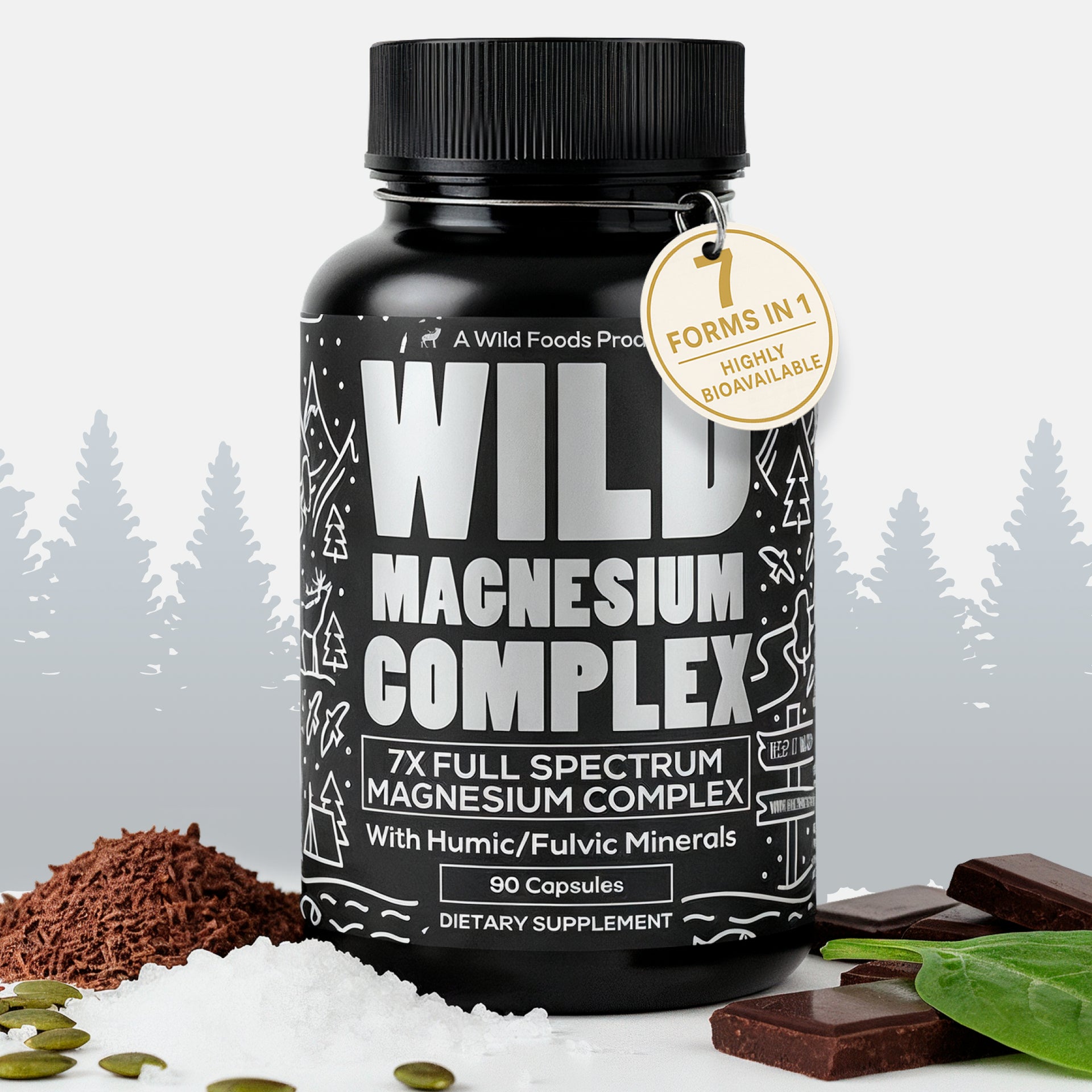
After hundreds of hours of research, sifting through dozens of high-quality studies on magnesium transport and tissue-specific bioavailability, and examining every multi-form magnesium formula on the market, only one product met every single one of these six requirements — and what we found during that investigation changed the way we think about mineral supplementation entirely.
The Story Behind the Formula
Colin Stuckert, founder of Wild Foods, built this product because he needed it. “I was doing everything right — magnesium glycinate every night, decent sleep on paper — but I was still getting calf cramps at the gym, my heart would flutter during stressful weeks, and I had this low-grade afternoon fatigue I couldn't shake. When I dug into the research, I found out glycinate was only solving one piece of a much bigger puzzle. When I started taking a real multi-form complex, the change was so profound that I knew I had to bring a Wild version to the market.” The brief: science-backed, whole-food-first, nothing synthetic — and broad enough to cover every magnesium-dependent system at once.
Introducing
Wild Magnesium Complex — 7 Forms
One capsule. Seven bioavailable forms. Every magnesium-dependent system covered at once.
✓ 7 bioavailable forms in one capsule
✓ Glycinate, Bisglycinate, Malate, Orotate, Taurate, Citrate & Carbonate
✓ Humic/Fulvic blend for enhanced absorption
✓ Supports sleep, muscles, heart & energy at once
✓ Free of soy, gluten, dairy, egg & sugar
✓ No fillers, binders, or artificial preservatives
✓ Formulated for total-system coverage, not one symptom
✓ 90-Day 100% Money-Back Guarantee
While stock lasts, you can save up to 20% on your first order of Wild Magnesium Complex — 7 forms, one capsule, every system covered.
CHECK AVAILABILITY →What Customers Are Reporting
Customer Results — Wild Magnesium Complex — 7 Forms
92%
report easier sleep within 2 weeks
<1%
refund request rate
4.7★
average rating from 1,000+ households
4x
sold out in the past 12 months
★★★★★ Verified Buyer
"I'd been taking a glycinate for a year and my sleep was fine, but the leg cramps never stopped. Two weeks into the 7-form complex and the cramps are just... gone. Didn't expect that."
— Marissa T.
★★★★★ Verified Buyer
"My cardiologist actually asked what changed after my last checkup — my heart palpitations basically disappeared. I'm assuming it's the taurate/orotate forms doing what glycinate never did for me."
— David R.
★★★★★ Verified Buyer
"The afternoon energy crash was my biggest complaint for years. Three months in, it's genuinely gone. Sleep improved too, but the energy piece is what sold me on refilling."
— Priya K.
What to Expect — Month by Month
MONTH 1 — Nervous System Calms Down
Sleep quality improves first as the glycinate component takes effect — falling asleep faster, fewer 3am wake-ups, less nighttime muscle twitching.
MONTHS 2–4 — Energy & Muscle Recovery Catch Up
As malate and citrate build tissue-level magnesium stores, afternoon energy crashes fade and muscle cramps or restless legs become noticeably less frequent.
MONTHS 4–6 — Cardiac, Cognitive & Bone Support Compound
Taurate, orotate, and L-threonate reach steady-state in cardiac and brain tissue — many report calmer heart rhythm, fewer tension headaches, and better focus by month 4–6.
Join the thousands of households who stopped treating 10 separate symptoms and started treating the one mineral gap behind them.
CHECK AVAILABILITY →A full month of Wild Magnesium Complex works out to less than $2 a day — about the cost of a small coffee — for coverage across seven forms most single-ingredient bottles don't even attempt.
⚠ SUPPLY UPDATE
Current batch: 74% claimed. This formula has sold out four times in the past year due to raw material sourcing on the taurate and orotate forms. Next restock is 3–5 weeks out. If you're reading this, stock is still available.
90-Day 100% Money-Back Guarantee
Take three full months. Feel the difference — or pay nothing, no questions asked. Less than 1% of customers have ever asked for it back.
Your sleep, your energy, and your heart rhythm can't wait on nine unsolved symptoms.
2026 batch — limited availability, order before the next sellout
TRY OUR RISK-FREE OFFER →90-Day Money-Back Guarantee · Third-Party Tested · Free Shipping Over $50
STUDIES & SOURCES REFERENCED ▾
- Workinger JL, Doyle RP, Bortz J. "Challenges in the Diagnosis of Magnesium Status." Nutrients. 2018. pmc.ncbi.nlm.nih.gov/articles/PMC6165781
- NIH Office of Dietary Supplements. "Magnesium: Fact Sheet for Health Professionals." ods.od.nih.gov
- Dean C, MD, ND. The Magnesium Miracle, 2nd Edition. Ballantine Books. 2017.
- DiNicolantonio JJ, O’Keefe JH, Wilson W. "Subclinical magnesium deficiency: a principal driver of cardiovascular disease and a public health crisis." Open Heart. 2018. pubmed.ncbi.nlm.nih.gov
- Boyle NB, Lawton C, Dye L. "The Effects of Magnesium Supplementation on Subjective Anxiety and Stress-A Systematic Review." Nutrients. 2017. pubmed.ncbi.nlm.nih.gov
- Rondanelli M, et al. "Effects of magnesium on sleep quality." Nutrients / clinical trials indexed on PubMed. pubmed.ncbi.nlm.nih.gov
- Assadi F. "Hypomagnesemia: an evidence-based approach to clinical cases." Iran J Kidney Dis, indexed on PubMed. pubmed.ncbi.nlm.nih.gov
*These statements have not been evaluated by the Food and Drug Administration. This product is not intended to diagnose, treat, cure, or prevent any disease.