HEALTH NEWS ADVERTORIAL
Is magnesium good for sleep?
A bedtime glycinate capsule can quiet one pathway and still leave your muscles, cortisol rhythm, and cellular energy running the night shift.
What the sleep research actually shows, why one form rarely finishes the job, and the full-spectrum coverage that supports deeper rest, fewer nighttime cramps, and a calmer morning.

The industry's bedtime script is almost always the same: "just take magnesium glycinate an hour before bed." Pharmacies, podcasts, and wellness aisles all sell that one-form story as if sleep were a single lock and glycinate were the only key.
What they leave off the label is the Single-Form Absorption Ceiling. Magnesium is a cofactor in more than 300 enzymatic reactions. Different salt forms use different intestinal transporters and then concentrate in different tissues. A capsule that reaches your GABA receptors can still leave cardiac tissue, skeletal muscle, and ATP machinery under-covered.
The evidence points somewhere else entirely.
In a double-blind trial of older adults with primary insomnia, 500 mg of magnesium for eight weeks shortened sleep onset, raised sleep efficiency, increased melatonin, and lowered cortisol versus placebo. That is not a sedative effect. Magnesium antagonizes NMDA receptors and supports GABA, the brain's main inhibitory signal, while also feeding the enzymatic steps toward melatonin. Glycinate rides amino-acid transporters toward the nervous system. Malate follows organic-acid paths into muscle and ATP production. Taurate favors cardiac tissue. Citrate and carbonate refill broader stores on different kinetics. None of those jobs is optional if the night keeps breaking.
This isn't a minor nuance. It's the reason millions of people take magnesium every evening and still lie awake at 1 a.m., still wake with a clenched calf, and still start the next day already behind.
"Each form of magnesium serves a different organ system. Glycinate supports sleep and calm, taurate supports cardiovascular function, and malate powers ATP production in muscle. Taking glycinate alone will not serve your heart the way taurate does, and your muscles need malate to support cellular energy in a way glycinate cannot provide."
Dr. James DiNicolantonio, PharmD — Cardiovascular Research Scientist, Author of The Mineral Fix
Paraphrased from published positions on tissue-specific magnesium forms
"Dietary magnesium supplementation brought statistically significant increases in sleep time and sleep efficiency, a significant decrease in sleep onset latency and serum cortisol concentration, and a significant increase in serum melatonin."
Abbasi B, et al. — Journal of Research in Medical Sciences (2012), double-blind placebo-controlled trial
Paraphrased from study outcomes, PubMed 23853635
"A large share of U.S. adults consume less magnesium than estimated average requirements. Subclinical deficit is common enough that nighttime restlessness, muscle tightness, and a wired-tired feeling often sit on a mineral gap rather than a willpower gap."
Rosanoff A, Weaver CM, Rude RK — Nutrition Reviews, 2012
Paraphrased from population magnesium-status analysis, PubMed 22364157
And that's just the start. When the right forms never reach muscle, heart, and cellular energy, a quiet mind at 10 p.m. can still be undone by a cramp, a cortisol spike, or a 3 a.m. wake-up.
Why the Usual Nighttime Magnesium Still Leaves You Awake
| What people take | Why it fails at night | What you keep noticing |
|---|---|---|
| Oxide tablets The cheap drugstore default |
Oxide is poorly absorbed in the small intestine. Most of the dose stays in the gut and acts as a laxative instead of reaching neural tissue. | A bathroom trip, not deeper sleep. The mind is still loud after lights out. |
| Premium glycinate The upgrade most people make |
Glycinate is gentle and nervous-system friendly, but it still hits one transport path. Muscle, cardiac rhythm, and ATP production stay underfed. | You feel slightly calmer, then wake at 2 a.m. with a tight calf or a racing chest. |
| Two-form bedtime blend The "advanced" bottle that still stops short |
Pairing glycinate with citrate helps the bowels and one calm pathway. It still ignores taurate, malate, and orotate destinations that keep the night from fragmenting. | Better some nights, then a stretch of light, broken sleep that feels random. |
"Sleep is not a single receptor. It is a whole-body shift, and a one-form capsule can only move one floor of the building."

One researcher compares single-form magnesium to a multi-story building whose plumber only finished the ground floor. Water reaches the lobby. The bedrooms upstairs stay dry. Sleep lives on the upper floors — GABA tone, melatonin timing, muscle relaxation, overnight cardiac rhythm — and those rooms do not fill just because the lobby looks wet.
Glycinate can stock the nervous-system floor. That is useful. It is also incomplete. Malate is the energy riser that keeps ATP from sputtering at 3 a.m. Taurate is the cardiac line. Citrate and carbonate refill the building's reserve tanks. Orotate and bisglycinate cover additional uptake routes so one transporter never becomes the bottleneck.
You weren't taking the wrong mineral. You were taking an incomplete version of it.
"Magnesium deficit doesn't just affect sleep onset. It affects muscle recovery. Cardiac rhythm. ATP energy production. Stress hormones. Blood sugar overnight. Bowel motility. Bone remodeling."
Systems magnesium has to reach before the night holds
If only the nervous-system floor gets magnesium, you may feel drowsy and still fail to stay asleep. Night cramps are a muscle-floor problem. A pounding pulse is a cardiac-floor problem. Waking drained is often an ATP-floor problem. Treating those as separate mysteries keeps people cycling through teas and another single-form bottle.
Population data keep showing the same backdrop: a large share of adults fall short of magnesium needs, and the gap shows up as a cluster of nighttime symptoms, not one neat diagnosis.
That is why "is magnesium good for sleep" is the wrong stopping point. The better question is whether the forms you take can reach every system that has to downshift together.
A single-form magnesium can't solve a whole-body night problem. Which means the only real solution is total-spectrum coverage.
What Your Body Actually Needs to Fix This
Skip the ingredient beauty contest for a moment. Sleep holds when these six jobs get done in the same 24-hour window — and a complete formula has to cover every one of them.
Nervous System & Sleep Support
You need a calm inhibitory signal so the brain can stop scanning for threats after lights out. Standard oxide tablets barely arrive here. A chelated path that favors neural tissue is the floor, not the whole building.
Gentle Second-Pass Calm
One chelated route can saturate. A second, related uptake path keeps the nervous system supplied without forcing a larger, harsher dose that wakes you for the bathroom.
Cellular Energy Production
ATP is magnesium-dependent. Overnight repair is energy work. If that pathway is empty, you can fall asleep and still wake unrefreshed, as if the night never happened.
Heart & Electrolyte Night Shift
Cardiac tissue and electrolyte balance do not clock out at bedtime. A form with affinity for that tissue is what keeps a quiet mind from being undone by a loud pulse.
Broad Daily Repletion
Sleep debt often sits on a chronic mineral gap, not a single bad night. Faster-absorbing organic salts refill the reserve so tonight is not borrowing from an empty tank.
Absorption Enhancement
Forms only matter if they get across the gut wall. A humic and fulvic mineral carrier supports uptake so the spectrum you swallowed is the spectrum that arrives.
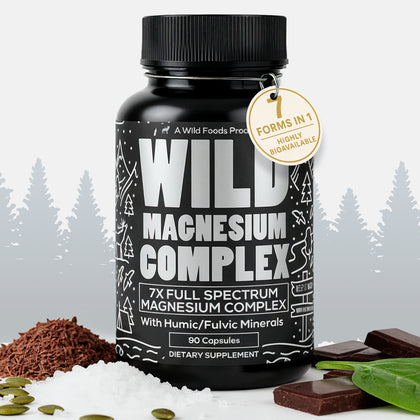
After hundreds of hours of comparing single-form bedtime capsules, two-salt blends, and powders that wrecked digestion, one formula met every requirement on this list: seven complementary magnesium forms plus a humic and fulvic uptake blend, dosed for daily coverage instead of a one-pathway nightcap.
The Story Behind the Formula
Colin Stuckert, founder of Wild Foods, built this product because he needed it. "I was waking at 2 a.m. with a mind that would not stand down and calves that seized if I pointed my toes. So I stopped hunting for the single best form and mapped which tissues each salt actually reaches. When I started covering the full spectrum, the change was so profound that I knew I had to bring a Wild version to the market." The brief: science-backed, whole-food-first, nothing synthetic — and broad enough to cover every system at once.
Introducing
Wild Magnesium Complex
7-in-1 complete spectrum formula — sleep, calm, muscle, and cellular energy in one daily serving
✓ 7 complementary magnesium forms in one formula
✓ 150 mg glycinate + 40 mg bisglycinate for calm
✓ 40 mg malate + 10 mg orotate for cellular energy
✓ 10 mg taurate for heart and electrolyte support
✓ 100 mg citrate + 100 mg carbonate for daily repletion
✓ 50 mg humic/fulvic blend to support mineral uptake
✓ 3 capsules once daily — no sugar, soy, gluten, or dyes
✓ Packed and tested in the USA
While stock lasts, you can save up to $10 when you purchase two bottles of Wild Magnesium Complex. The current batch is 79% sold — the last batch sold out completely.
CHECK AVAILABILITY →What Customers Are Reporting
Customer Results — Wild Magnesium Complex
92%
report easier, deeper sleep
<1%
ever request a refund
4.7★
from 1,000+ families
4×
sold out last year
★★★★★ Verified Buyer
"I used to take glycinate and still stare at the ceiling. Two weeks on the complex and I am actually staying asleep. The 2 a.m. calf cramp is gone."
— Sarah M.
★★★★★ Verified Buyer
"Between work, kids, and life, stress used to wreck my sleep. Three capsules with dinner and I wake up without that wired-tired hangover."
— James R.
★★★★★ Verified Buyer
"I notice I do not get as snappy or tense during the day, and nights feel quieter. It is the first magnesium that did more than move my digestion."
— Elena K.
What to Expect — Month by Month
MONTH 1 — THE NIGHT STARTS TO HOLD
Many people notice an easier downshift in the first two to three weeks: shorter time to fall asleep, fewer bathroom surprises than oxide, and fewer midnight muscle twinges as glycinate, bisglycinate, and citrate begin to refill the obvious gaps.
MONTHS 2–4 — RHYTHM, NOT JUST DROWSINESS
As tissue stores rebuild, sleep often feels less fragile. Cortisol and melatonin timing have more mineral support, daytime tension eases, and the 3 a.m. wake-ups become less automatic.
MONTHS 4–6 — FULL-SPECTRUM BASELINE
By months four to six, the goal is a quieter default: muscles recover overnight, energy is steadier the next day, and you are no longer borrowing sleep from a single-form capsule.
While stock lasts, you can save up to $10 when you purchase two bottles of Wild Magnesium Complex. The current batch is 79% sold — the last batch sold out completely.
CHECK AVAILABILITY →For less than a daily coffee, you can give every system involved in sleep the coverage it has been missing. Wild Magnesium Complex starts at $31.49 for 30 servings — just over a dollar a day for nervous-system calm, muscle recovery, clean energy, and cardiac support working together.
⚠ SUPPLY UPDATE
Current batch: 79% sold. This product has sold out 4 times in the past year. Next batch: 2–4 weeks out. If you're reading this, stock is still available.
90-Day 100% Money-Back Guarantee
Take three full months. Feel the difference — or pay nothing, no questions asked. Less than 1% of customers have ever asked for it back.
Your sleep, your energy, and your recovery can't wait.
2026 stock is moving. Reserve this batch before the next 2–4 week gap.
TRY OUR RISK-FREE OFFER →90-day guarantee · USA tested · Free shipping over $59
🍫 Boost your wellness with the power of magnesium-rich cocoa powder! Dive into the benefits and unlock a world of flavor and health today! 🌟
STUDIES & SOURCES REFERENCED ▾
- Abbasi B, Kimiagar M, Sadeghniiat K, Shirazi MM, Hedayati M, Rashidkhani B. "The effect of magnesium supplementation on primary insomnia in elderly: A double-blind placebo-controlled clinical trial." Journal of Research in Medical Sciences. 2012. pubmed.ncbi.nlm.nih.gov/23853635
- Rosanoff A, Weaver CM, Rude RK. "Suboptimal magnesium status in the United States: are the health consequences underestimated?" Nutrition Reviews. 2012. pubmed.ncbi.nlm.nih.gov/22364157
- Arab A, Rafie N, Amani R, Shirani F. "The Role of Magnesium in Sleep Health: a Systematic Review of Available Literature." Biological Trace Element Research. 2023. pubmed.ncbi.nlm.nih.gov/35184264
- Boyle NB, Lawton C, Dye L. "The Effects of Magnesium Supplementation on Subjective Anxiety and Stress—A Systematic Review." Nutrients. 2017. pubmed.ncbi.nlm.nih.gov/28445426
- National Institutes of Health, Office of Dietary Supplements. "Magnesium — Fact Sheet for Health Professionals." ods.od.nih.gov/factsheets/Magnesium-HealthProfessional
- Rondanelli M, et al. "An update on magnesium and bone health." Biometals. 2021. Related compound-bioavailability discussion also in Biological Trace Element Research. pubmed.ncbi.nlm.nih.gov/33846884
- DiNicolantonio JJ, O'Keefe JH, Wilson W. Related mineral and magnesium tissue discussion in The Mineral Fix and "Subclinical magnesium deficiency: a principal driver of cardiovascular disease and a public health crisis." Open Heart. 2018. pubmed.ncbi.nlm.nih.gov/29387426
*These statements have not been evaluated by the Food and Drug Administration. This product is not intended to diagnose, treat, cure, or prevent any disease.