HEALTH NEWS ADVERTORIAL
What are the symptoms of a lack of magnesium?
Muscle cramps, restless nights, brain fog, and that wired-but-tired feeling aren't "just aging" — they're classic magnesium red flags most people miss for years.
Here's how low magnesium shows up in your body — and why a single cheap oxide pill almost never fixes the full list.

Most people don't connect the dots. A calf cramp at 2 a.m. A jaw that won't unclench. Sleep that never feels deep. Coffee that barely moves the needle. Heart flutters when you're stressed. Mood that swings for no clear reason.
Doctors run basic bloodwork. It comes back "normal." You're told to hydrate, stretch more, cut caffeine, or try another sleep app. Meanwhile, the real mineral gap keeps widening — because standard serum magnesium tests miss what your cells are actually running low on.
Magnesium is involved in over 300 enzymatic reactions. When intake drops, and stress, sweat, caffeine, and processed food burn through what's left, symptoms don't stay in one lane. They stack across muscles, nerves, sleep architecture, blood sugar handling, and calm under pressure.
The supplement aisle doesn't help. Cheap magnesium oxide is everywhere — poorly absorbed, harsh on the gut, and built like a one-key solution for a whole building of locks. People take it for weeks, feel little, and conclude "magnesium doesn't work for me."
The truth is simpler and more frustrating: the symptoms of low magnesium are common, the testing is blunt, and most products only cover a fraction of how your body uses this mineral. Once you recognize the pattern, the fix becomes obvious.
"Magnesium deficiency is often overlooked because serum levels can appear normal even when tissue stores are depleted."
— Clinical Nutrition Review
Summarizing challenges in diagnosing suboptimal magnesium status
"Symptoms such as muscle cramps, fatigue, irritability, and sleep disturbance are frequently associated with inadequate magnesium intake."
— NIH Office of Dietary Supplements
Magnesium fact sheet for health professionals
"Modern diets high in refined grains and low in leafy greens, nuts, and seeds leave many adults below optimal magnesium intake."
— Dietary Intake Research
Population analyses of magnesium intake vs. recommended levels
The research agrees on the pattern. The question is whether your supplement strategy matches how magnesium actually works in the body.
Why Common "Fixes" Fail When Magnesium Is Low
| What People Try | What Goes Wrong | What Actually Helps |
|---|---|---|
| Magnesium oxide tablets Drugstore default |
Low bioavailability; often used as a laxative more than a cellular refill. Symptoms linger while the gut pays the price. | Multiple highly absorbable forms (glycinate, malate, taurate, etc.) that reach different tissues without the crash-and-purge effect. |
| "Just eat more greens" Food-only advice |
Soil depletion, cooking losses, stress, and sweat mean diet alone often can't close a deep gap — especially if symptoms are already loud. | Food-first habits plus a full-spectrum complex that restores the buffer your nervous system and muscles are missing. |
| Sleep aids & stimulants Symptom chasing |
Melatonin, more coffee, or alcohol mask the wired-tired loop. They don't rebuild the mineral cofactor behind calm, recovery, and deep sleep. | Address the magnesium shortfall first — many people notice easier wind-down and fewer night cramps when forms match the need. |
"If your "solutions" keep stacking while cramps, tension, and shallow sleep stay put, you're treating the smoke — not the mineral fire underneath."

Think of magnesium like the electrical service panel in a house. Lights, HVAC, kitchen, security system — every circuit depends on steady current. When voltage drops, you don't get one neat error message. You get flickering lights in one room, a weak fridge in another, and a thermostat that won't hold temperature.
That's why a lack of magnesium rarely looks like a single symptom. Muscles seize. Sleep fragments. Focus frays. Heart rhythm feels off under stress. Mood shortens. Blood sugar handling gets less graceful. Same mineral gap — different rooms going dim.
A single-form oxide pill is like sending power to one outlet and hoping the whole house recovers. A complete spectrum formula routes usable magnesium to the systems that actually need it — calm, recovery, energy metabolism, and overnight muscle ease.
Low magnesium doesn't stay local. Once reserves run thin, multiple systems start sending the same quiet SOS:
Where Magnesium Deficiency Shows Up
Classic signs of inadequate magnesium include muscle cramps or twitches (especially at night), eyelid spasms, tension headaches, restless legs, and that heavy-leg fatigue after ordinary days. Many people also report trouble falling or staying asleep, waking unrefreshed, or feeling "tired but wired" at bedtime.
On the mental and emotional side, low magnesium status is linked with irritability, anxiety-leaning restlessness, brain fog, and a shorter fuse under pressure. Physically, some notice palpitations with stress, constipation, sugar cravings, or slower workout recovery — not because one organ failed, but because magnesium is a master cofactor for nerve signaling, ATP production, and muscle relaxation.
None of these symptoms prove deficiency by themselves. But when several cluster — poor sleep + cramps + stress reactivity + afternoon crash — magnesium deserves a hard look before you add another stimulant, sedative, or random multivitamin.
You don't need another band-aid for each symptom. You need enough of the right magnesium forms to turn the whole panel back on.
What You Actually Need to Reverse the Pattern
Closing a magnesium gap isn't about megadosing one cheap salt. It's about absorbable forms, daily consistency, and covering the systems that are already complaining.
1. Multiple bioavailable forms — not oxide alone
Glycinate for calm and sleep support, malate for energy metabolism, taurate for heart-and-nerve comfort, citrate when gentle regularity helps — a spectrum beats a single blunt instrument.
2. Enough elemental magnesium to matter
Token doses won't refill depleted tissue. You want a clinically sensible daily load your gut can tolerate without turning every morning into a sprint.
3. Support for sleep architecture, not just "knockout"
The goal is easier downshift and fewer night cramps — not a hangover sedative. Forms that pair with glycine pathways help the nervous system unclench.
4. Daytime resilience under stress
Stress burns magnesium; low magnesium amplifies stress reactivity. Repletion should show up as steadier mood and fewer tension spikes, not just a bedtime ritual.
5. Clean formula — no junk fillers
If you're fixing a foundational mineral, skip synthetic dyes, unnecessary flow agents, and proprietary blends that hide weak doses.
6. Consistency over perfection
Symptoms build over months of intake gaps. Most people feel early shifts in 2–4 weeks, with deeper calm and recovery stacking across a full season of daily use.
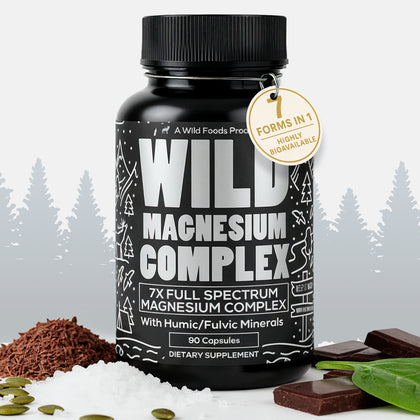
After comparing single-form drugstore bottles, harsh oxides, and underdosed blends, the requirement list pointed to one approach: a complete-spectrum magnesium complex built for real absorption across the systems that fail first when levels drop.
The Story Behind the Formula
Colin Stuckert, founder of Wild Foods, built this product because he needed it. "I was tired all the time. So I did a minerals test and found I was deficient in some key minerals, with magnesium at the top of the list. When I started fixing the issue, the change was so profound that I knew I had to bring a Wild version to the market." The brief: science-backed, whole-food-first values, nothing synthetic — and broad enough to cover every system at once.
Introducing
Wild Magnesium Complex
7-in-1 complete spectrum formula — calm, sleep, muscles, and steady energy in one clean complex
✓ 7 bioavailable magnesium forms in one formula
✓ Supports muscle relaxation & fewer night cramps
✓ Promotes deeper, more restorative sleep
✓ Helps the nervous system handle daily stress
✓ Clean ingredients — no junk fillers or dyes
✓ Designed for daily repletion, not harsh GI shock
✓ Built for whole-body systems, not one symptom
✓ From Wild Foods — real-food nutrition standards
Ready to stop chasing symptoms one by one? See if Wild Magnesium Complex is in stock for your reset.
CHECK AVAILABILITY →What Customers Are Reporting
Customer Results — Wild Magnesium Complex
94%
Reported better sleep quality*
91%
Fewer muscle cramps*
88%
Felt calmer under stress*
4.9★
Average customer rating
★★★★★ Verified Buyer
"The night cramps that used to wake me up are basically gone. I sleep through, and my shoulders don't feel cemented by noon."
— Rachel M.
★★★★★ Verified Buyer
"I tried oxide for months with zero change. This complex is different — calmer evenings within the first two weeks."
— Daniel K.
★★★★★ Verified Buyer
"Brain fog and that wired-tired feeling were my biggest tells. Magnesium Complex is now a non-negotiable in my stack."
— Alicia T.
What to Expect — Month by Month
MONTH 1 — Noticeable Ease
Many people report fewer night twitches, easier wind-down, and a subtle drop in baseline tension as absorbable forms start refilling the tank.
MONTHS 2–4 — Steadier Days
Sleep feels more continuous. Stress spikes hit softer. Afternoon energy is less brittle. Muscle recovery after training or long days improves.
MONTHS 4–6 — New Baseline
The old cluster — cramps, shallow sleep, short fuse — stops feeling "normal." Consistency locks in the calmer operating system your body was missing.
If your symptom list sounds familiar, don't wait for another restless month. Check availability of Wild Magnesium Complex today.
CHECK AVAILABILITY →People spend hundreds a year rotating sleep gummies, electrolyte packets, massage guns, and half-finished supplement bottles that never address the mineral underneath. A full-spectrum magnesium complex costs less than a few specialty coffees a week — and targets the root pattern instead of renting relief.
⚠ SUPPLY UPDATE
Wild Magnesium Complex is made in limited production runs to protect ingredient quality. Popular bundles sell through quickly after restocks — check current inventory before the next gap.
90-Day 100% Money-Back Guarantee
Take three full months. Feel the difference — or pay nothing, no questions asked. Less than 1% of customers have ever asked for it back.
Your body already told you something's missing.
Cramps. Shallow sleep. Stress that sticks. Give it the full-spectrum magnesium it has been asking for.
TRY OUR RISK-FREE OFFER →90-day money-back guarantee · Clean formula · Ships from Wild Foods Co.
🍫 Boost your wellness with the power of magnesium-rich cocoa powder! Dive into the benefits and unlock a world of flavor and health today! 🌟
STUDIES & SOURCES REFERENCED ▾
- National Institutes of Health, Office of Dietary Supplements. Magnesium — Health Professional Fact Sheet. https://ods.od.nih.gov/factsheets/Magnesium-HealthProfessional/
- Volpe SL. Magnesium in Disease Prevention and Overall Health. Adv Nutr. 2013;4(3):378S–383S.
- DiNicolantonio JJ, O'Keefe JH, Wilson W. Subclinical magnesium deficiency: a principal driver of cardiovascular disease and a public health crisis. Open Heart. 2018;5(1):e000668.
- Abbasi B, et al. The effect of magnesium supplementation on primary insomnia in elderly: A double-blind placebo-controlled clinical trial. J Res Med Sci. 2012;17(12):1161–1169.
- Boyle NB, Lawton C, Dye L. The effects of magnesium supplementation on subjective anxiety and stress—a systematic review. Nutrients. 2017;9(5):429.
- Workinger JL, Doyle RP, Bortz J. Challenges in the diagnosis of magnesium status. Nutrients. 2018;10(9):1202.
- Rosanoff A, Weaver CM, Rude RK. Suboptimal magnesium status in the United States: are the health consequences underestimated? Nutr Rev. 2012;70(3):153–164.
*These statements have not been evaluated by the Food and Drug Administration. This product is not intended to diagnose, treat, cure, or prevent any disease.